 Skip to main content
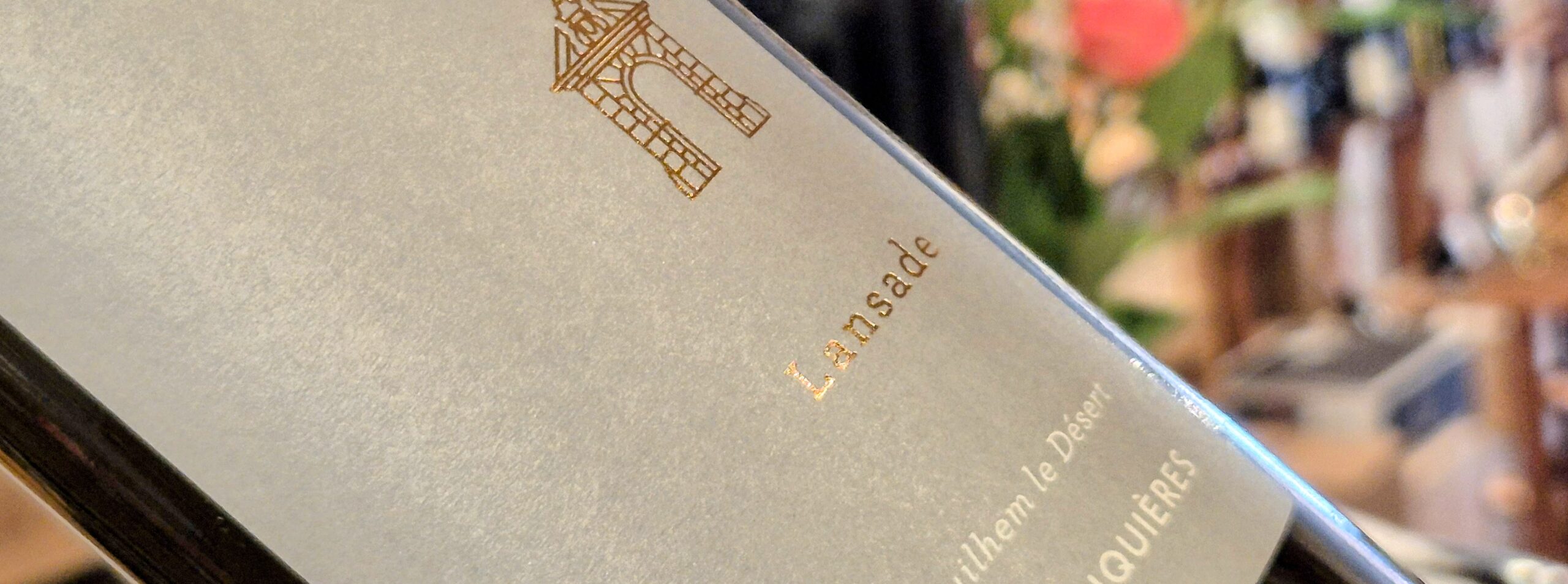
When Chenin Blanc meets the Mediterranean landscape of Saint Guilhem le Désert
When we think of the Languedoc, our minds naturally turn towards sunshine, Mediterranean herbs and generous red wines.
But the region is capable of producing some wonderfully fresh and distinctive whites too.
The Lansade 2024 from Château de Jonquières is a beautiful example.
Made in the IGP Saint Guilhem le Désert, within the spectacular landscape of the Terrasses du Larzac, it brings together four grape varieties that you might not immediately expect to see in the same bottle.
And at the heart of the blend is a grape more commonly associated with the Loire Valley: Chenin Blanc.
Four grapes, one Mediterranean identity
Lansade is built around 50% Chenin Blanc, complemented by 30% Grenache Blanc, 10% Rolle and 10% Terret Bourret.
Each variety brings something different.
The Chenin contributes freshness, tension and a certain mineral character.
Grenache Blanc adds texture and generosity, while Rolle—better known as Vermentino in other parts of the Mediterranean—brings floral and citrus notes.
Terret Bourret, a much less familiar southern French variety, completes the blend with its own freshness and personality.
Together, they create something much more interesting than the sum of their parts.
A white born from the Terrasses du Larzac
The vineyards lie on clay-limestone gravel soils, or cailloutis argilo-calcaires, characteristic of the Terrasses du Larzac area.
This combination of stones, clay and limestone is particularly interesting for white wines.
The stones help with drainage and heat, while the clay retains water. The limestone contributes to the freshness and mineral sensation that can give southern whites a remarkable sense of balance.
It is a terroir capable of producing ripe fruit without necessarily producing heavy wines.
And that is exactly what makes Lansade so appealing.
The philosophy of Château de Jonquières
Château de Jonquières is one of those estates where the history of the family and the personality of the people working the vines are inseparable from the wines.
Charlotte and Clément de Béarn continue the work of a family deeply rooted in this remarkable corner of the Languedoc, combining respect for the estate’s heritage with a very personal approach to winemaking.
Their wines often have a strong sense of individuality.
They are not made simply to fit an expected idea of what a Languedoc wine should be.
Lansade is a perfect example.
Freshness before heaviness
The grapes are harvested by hand before undergoing direct pressing.
After a cold settling period, fermentation takes place under controlled temperatures, with the wine then aged in stainless-steel tanks.
There is no oak to impose additional flavours or aromas.
Instead, the focus remains firmly on the fruit, the freshness and the character of the vineyard.
The result is a white that feels bright and precise, with ripe orchard and citrus fruit, floral touches and a subtle Mediterranean generosity.
The Chenin gives the wine its backbone, while the southern varieties bring texture and warmth.
A different side of the Languedoc
Perhaps what we love most about Lansade is that it challenges our expectations.
This isn’t the obvious Languedoc white.
It doesn’t rely on richness or oak to make an impression.
Instead, it shows how diverse the region can be — and how intelligently a grape variety traditionally associated with another part of France can adapt to a completely different landscape.
Chenin Blanc may have found its most famous home in the Loire, but here, surrounded by the hills and limestone landscapes of the Terrasses du Larzac, it tells a very different story.
Why we love it at The French Paradox
Lansade 2024 is the kind of bottle that makes you stop and look twice at the label.
Chenin Blanc, Grenache Blanc, Rolle and Terret Bourret.
Saint Guilhem le Désert.
Terrasses du Larzac.
Château de Jonquières.
It may not be the combination you expected.
But that is precisely the point.
It is fresh, characterful and unmistakably southern, while showing that the Languedoc has far more to offer than the wines we already know.


Recent Comments