 Skip to main content
A small Languedoc appellation, old vines and a clever touch of oak
Sauvignon Blanc is one of the world’s most recognisable white grapes.
Think Sancerre, Pouilly-Fumé, perhaps Bordeaux.
But the Languedoc?
That is where things become rather more interesting.
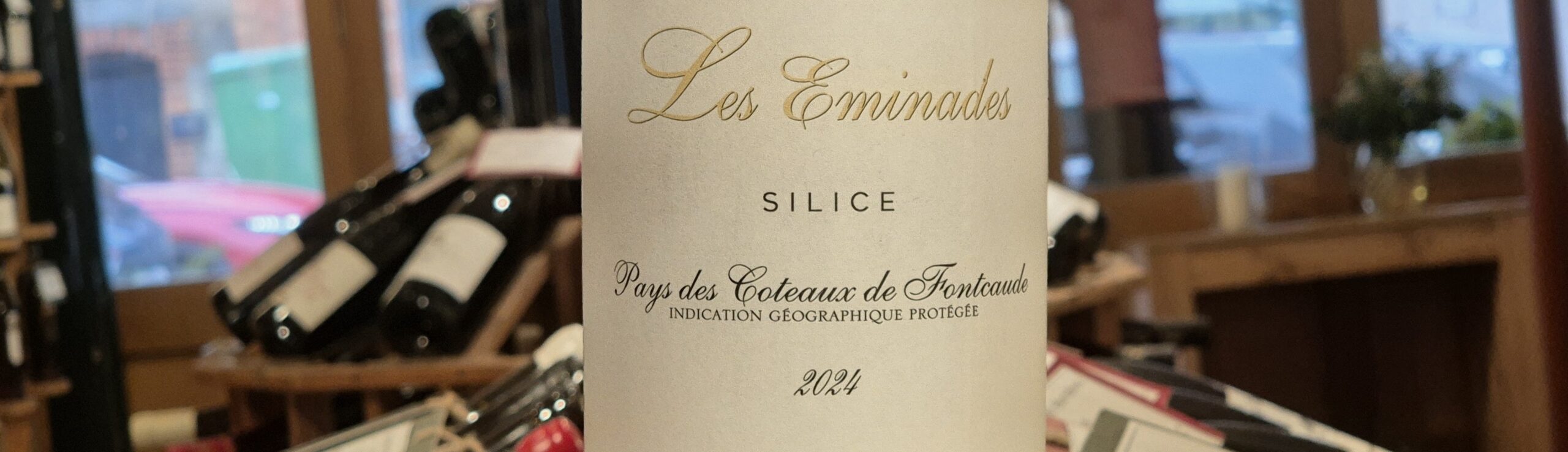
At Les Éminades, Patricia and Luc have taken Sauvignon Blanc in a completely different direction. Their Silice 2024 comes from the tiny Vin de Pays des Coteaux de Fontcaude, where 40-year-old vines grow on a distinctive mix of clay, silica and silt.
The result is a Sauvignon Blanc that feels familiar — but behaves rather differently.
Sauvignon Blanc, somewhere unexpected
The Languedoc is better known for Grenache, Syrah, Mourvèdre and Carignan than for Sauvignon Blanc.
Yet the region has plenty of different microclimates and soils, and in the right hands, the grape can produce something far removed from the intensely grassy, citrus-driven style often associated with cooler climates.
Silice shows exactly why.
The warm Mediterranean surroundings give the wine generosity and ripe fruit, while the vineyard’s clay-siliceous-silty soils and the estate’s approach to farming preserve freshness and character.
It is Sauvignon Blanc, certainly.
Just not the Sauvignon Blanc you might be expecting.
The story is in the name
Silice is French for silica — a mineral found in the vineyard’s soil.
Here, the vines grow at around 170 metres above sea level in clay, silica and silt.
It is a simple name, but an appropriate one: rather than hiding the origins of the wine behind a grand appellation, Silice points directly back to the ground beneath the vines.
And that is very much in keeping with the philosophy at Les Éminades.
Forty-year-old Sauvignon Blanc
The vineyard was planted in 1984, meaning these are now mature Sauvignon Blanc vines with more than four decades in the ground.
They are farmed without herbicides, with the soil worked mechanically and the vines trained in the traditional goblet form.
The grapes are harvested by hand in small crates, followed by rigorous sorting before they enter the winery.
Yields are deliberately modest at just 27 hectolitres per hectare, allowing the estate to work with healthy, concentrated fruit.
Fermentation first, oak afterwards
The winemaking is where Silice takes another turn.
The grapes are directly pressed before settling, and fermentation begins spontaneously with native yeasts.
The wine is then transferred quickly into 400-litre oak barrels, where it spends ten months ageing on its lees.
That is an important detail.
This is not Sauvignon Blanc covered in obvious vanilla or toast. The larger 400-litre barrels allow the wine to develop texture and complexity without making the oak the main character.
The lees ageing gives the wine additional roundness and depth, while the fruit and freshness remain at the centre.
It is a clever use of oak: not to change the wine, but to give it another dimension.
A different side of the Languedoc
Silice is a reminder that the Languedoc is not one single style of wine.
Behind the famous Mediterranean reds and powerful southern whites lies a huge diversity of soils, elevations and grape varieties.
Les Éminades, created in 2002, have built their estate around that diversity, farming organically and biodynamically and allowing the vineyard to play an important role in the final wine.
Silice is one of their more unusual expressions.
A Sauvignon Blanc from the Languedoc.
A wine from a tiny appellation.
Old vines.
And ten months in oak.
Put all of those things together and you get something that is difficult to categorise — which is exactly what makes it so enjoyable.
Why we love it at The French Paradox
Some wines are interesting because they come from famous places.
Others are interesting because they make you rethink a grape you thought you already knew.
Les Éminades Silice 2024 belongs to the second category.
It takes Sauvignon Blanc out of its usual comfort zone and gives it a distinctly Languedoc personality: generous, textured and shaped by its vineyard, with the oak quietly adding depth in the background.
Small appellation, old vines, unusual soil and thoughtful winemaking.
Sometimes the most memorable wines are the ones that refuse to fit neatly into a box.


Recent Comments