 Skip to main content
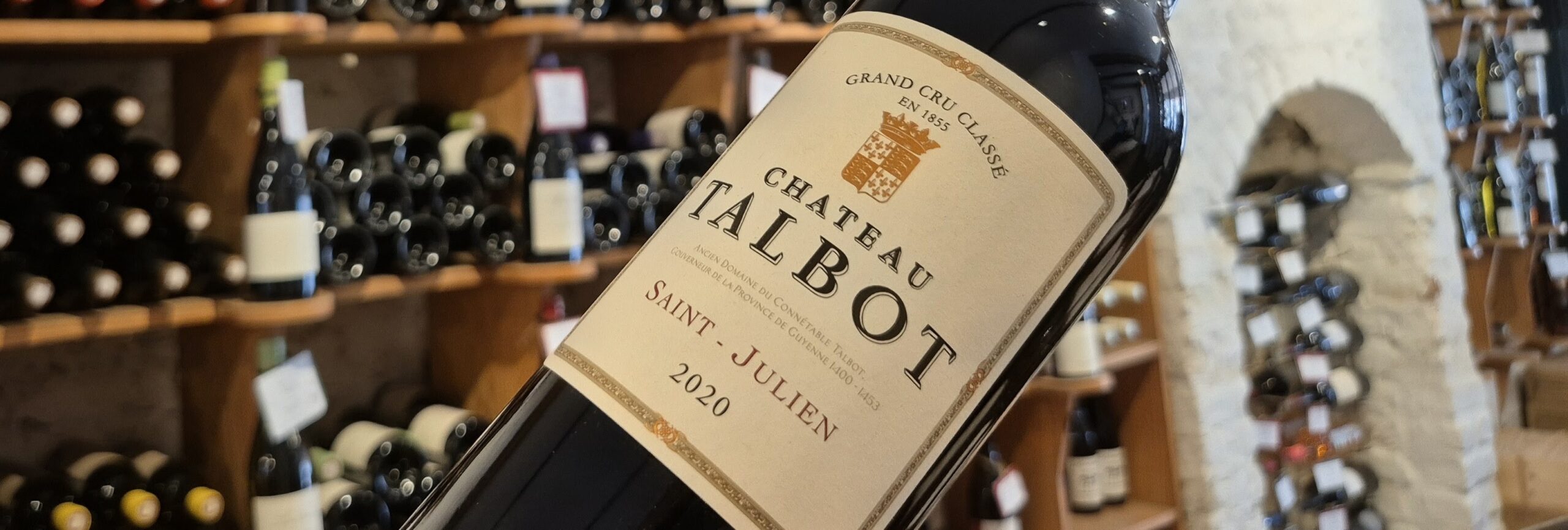
A Saint-Julien with more Cabernet Sauvignon than ever before
There are some Bordeaux wines that need no introduction.
Château Talbot is one of them.
A Saint-Julien, a Fourth Growth of the 1855 Classification, and one of the most recognisable names in the Médoc.
But the 2020 vintage gives us a particularly interesting reason to look at Talbot again.
This year, Cabernet Sauvignon takes centre stage like never before.
At 76% of the blend, it represents the highest proportion of Cabernet Sauvignon in the history of Château Talbot.
And that changes the conversation.
A vineyard almost as large as a small appellation
One of the things that surprises people about Talbot is its sheer size.
The estate’s vineyard covers almost 100 hectares in a single block, right in the heart of Saint-Julien.
That’s unusual in Bordeaux.
Rather than being scattered across numerous small parcels, Talbot forms one enormous vineyard surrounding the château and stretching towards the northern boundary of the appellation, close to Pauillac.
The soils are classic Médoc: layers of gravel deposited over much older clay and limestone.
These gravelly soils are particularly well suited to Cabernet Sauvignon.
They drain quickly after rain, while the stones absorb the sun’s heat and release it gradually back to the vines.
In other words, the vineyard itself is almost designed for Cabernet.
Why 76% Cabernet Sauvignon matters
Traditionally, Saint-Julien sits somewhere between the power of Pauillac and the elegance of Margaux.
And Talbot has always had its own interpretation of that balance: generous fruit, structure, freshness and famously polished tannins.
But the 2020 blend pushes the Cabernet element further than ever:
76% Cabernet Sauvignon
21% Merlot
3% Petit Verdot
It is a striking change from the more traditional proportions we often associate with Bordeaux.
The result is a wine with greater definition and structure, while retaining Talbot’s characteristic generosity.
Expect blackcurrant, blackberry and dark fruit, alongside the classic Cabernet signatures of graphite, cedar and spice.
The tannins are substantial, but beautifully polished.
2020: a year of extremes
The vintage itself played an important role.
The beginning of 2020 was exceptionally wet, allowing the soils to build up significant water reserves.
Then summer arrived.
Hot.
Dry.
And remarkably long.
The dry conditions continued through September and into October, allowing the Cabernet Sauvignon to reach excellent phenolic maturity.
At Talbot, harvesting took place between 11 September and 1 October, with the grapes picked by hand and subjected to successive sorting — first manually, then with optical technology.
The combination of a warm, dry season and the estate’s gravelly soils created ideal conditions for a Cabernet-dominated wine.
A château with an English name
There is also a little piece of medieval history hidden behind the label.
Talbot takes its name from John Talbot, the English Earl of Shrewsbury and Constable of France, who fought during the Hundred Years’ War.
He was defeated and killed at the Battle of Castillon in 1453, one of the final major battles of the conflict.
Whether the modern château was directly associated with him is part history and part legend, but the name has survived for centuries.
And there is something wonderfully Bordeaux about drinking a wine whose name carries you back more than 500 years.
Four generations of Cordiers
The modern history of Talbot is just as fascinating.
The estate was acquired by Désiré Cordier in 1918, and it has remained in the Cordier family ever since.
Today, Nancy Bignon-Cordier represents the fourth generation of the family to oversee the property.
That continuity is remarkable.
Four generations, one estate, and almost a century of family history — all while Bordeaux itself has changed enormously.
And Talbot makes a white wine?
Here’s something many people don’t know.
Talbot also produces a white wine called Caillou Blanc.
It has a fascinating history because Nancy Bignon-Cordier’s grandfather, Georges Cordier, was one of the pioneers of replanting white grape varieties in the Médoc during the 1930s.
Today, Caillou Blanc is predominantly Sauvignon Blanc with Sémillon and is made in a style that draws inspiration from Burgundy, including barrel ageing on the lees.
So behind this famous red Bordeaux château lies another, much less familiar story: Talbot has been making serious white wine in the Médoc for almost a century.
Talbot 2020: a different side of a classic
The 2020 is still unmistakably Talbot.
It has the generosity and approachability for which the château is known, but the unusually high proportion of Cabernet Sauvignon gives the wine an extra sense of structure, definition and depth.
It is powerful without being heavy.
Classic without being old-fashioned.
And perhaps most importantly, it shows how a great Bordeaux château can evolve while remaining recognisably itself.
Château Talbot 2020 — the year Cabernet Sauvignon took the lead.
And at 76%, it has never led quite so convincingly before.


Recent Comments