 Skip to main content
A historic terroir, a dual identity, and the refinement of Graves
Some appellations define Bordeaux as a whole. Pessac-Léognan is one of them — not only for the quality of its wines, but for its history. This is where Bordeaux winemaking began, just south of the city itself, in a landscape of gravel soils and forest clearings that has shaped some of the region’s most distinctive wines.
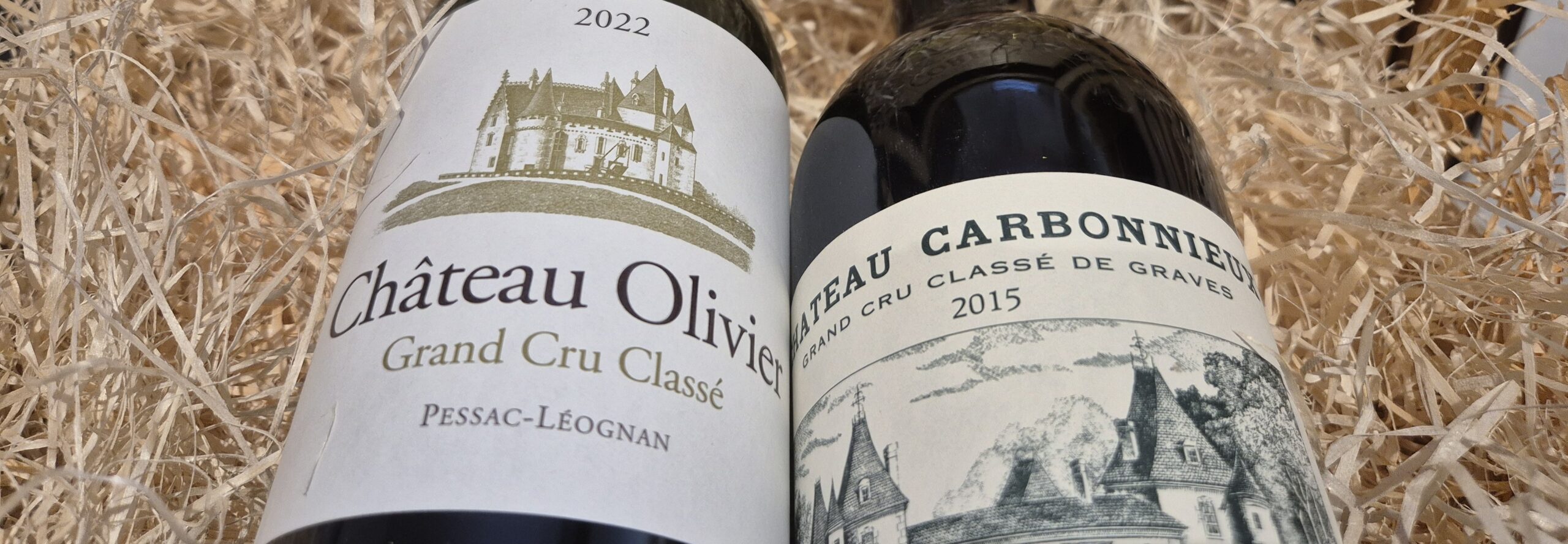
Let us introduce you to a white and a red that reflect this dual identity: the Château Olivier Blanc 2022 and the Château Carbonnieux Rouge 2015, both from classified growths that embody the elegance and depth of the appellation.
From Graves to Pessac-Léognan
Before becoming an appellation in its own right in 1987, Pessac-Léognan was part of the broader Graves region — the historic heart of Bordeaux wines. The name “Graves” itself refers to the gravelly soils that define the area, soils that are particularly well suited to viticulture.
These gravel beds, deposited over millennia by the Garonne river, provide excellent drainage and help regulate temperature, allowing grapes to ripen slowly and evenly. The result is a style of wine that combines ripeness with freshness, structure with elegance.
Unlike the Médoc further north, Pessac-Léognan has always been known for producing both great red and great white wines — something relatively rare in Bordeaux.
A balance between structure and refinement
In red wines, the blends are typically built around Cabernet Sauvignon and Merlot, sometimes supported by smaller amounts of Cabernet Franc or Petit Verdot. The wines tend to show dark fruit, subtle spice, and a characteristic smoky or earthy note often associated with the gravel soils.
What sets Pessac-Léognan apart is its balance. The wines have structure and ageing potential, yet they rarely feel austere. There is a refinement here — a sense of polish — that makes them both approachable and complex.
For whites, the combination of Sauvignon Blanc and Sémillon creates wines of remarkable precision. Sauvignon Blanc brings freshness and aromatic lift, while Sémillon adds texture and depth. Together, they produce wines that are both vibrant and layered, capable of evolving beautifully over time.
The classification of Graves
While much of Bordeaux relies on the famous 1855 classification, Pessac-Léognan follows a slightly different system. In 1953 (and revised in 1959), a specific classification was established for the Graves region: the Graves Classification.
Unlike the Médoc classification, this system does not rank wineries hierarchically. Instead, it recognises a group of properties as Grands Crus Classés, without dividing them into first, second, or third growths. Many of these classified estates are located within today’s Pessac-Léognan appellation.
This approach reflects a different philosophy: rather than ranking, it highlights a consistent level of excellence across a group of producers.
Two wines, one identity
The wines we offer provide a clear illustration of this identity.
The Château Olivier Blanc 2022, a Grand Cru Classé, expresses the precision of Pessac-Léognan whites. It combines freshness and aromatic clarity with a subtle richness, offering citrus and floral notes alongside a textured, elegant palate. It is a wine that feels both vibrant and composed.
The Château Carbonnieux Rouge 2015, also a Grand Cru Classé, shows the depth and structure of the appellation in a great vintage. The 2015 brings ripeness and generosity, layered with dark fruit and refined tannins, while maintaining the balance and elegance that define the region. It is a wine that already offers pleasure, yet still holds the potential to evolve further.
A defining expression of Bordeaux
Pessac-Léognan holds a unique place within Bordeaux. It combines history, terroir, and versatility, producing wines that reflect both strength and refinement.
Through its reds and whites, and through estates like Château Olivier and Château Carbonnieux, the appellation offers a complete picture of what Bordeaux can be — structured yet elegant, expressive yet balanced.
It is, in many ways, where the essence of Bordeaux becomes most clearly visible.


Recent Comments