 Skip to main content
A family estate, old-fashioned patience, and a wine made with as little intervention as possible
When people hear the word Beaujolais, they often think of easy-drinking wines meant to be enjoyed young. While there is certainly truth in that tradition, the region is capable of producing wines of remarkable depth and character. Among its ten crus, Moulin-à-Vent is often considered the most structured and age-worthy.
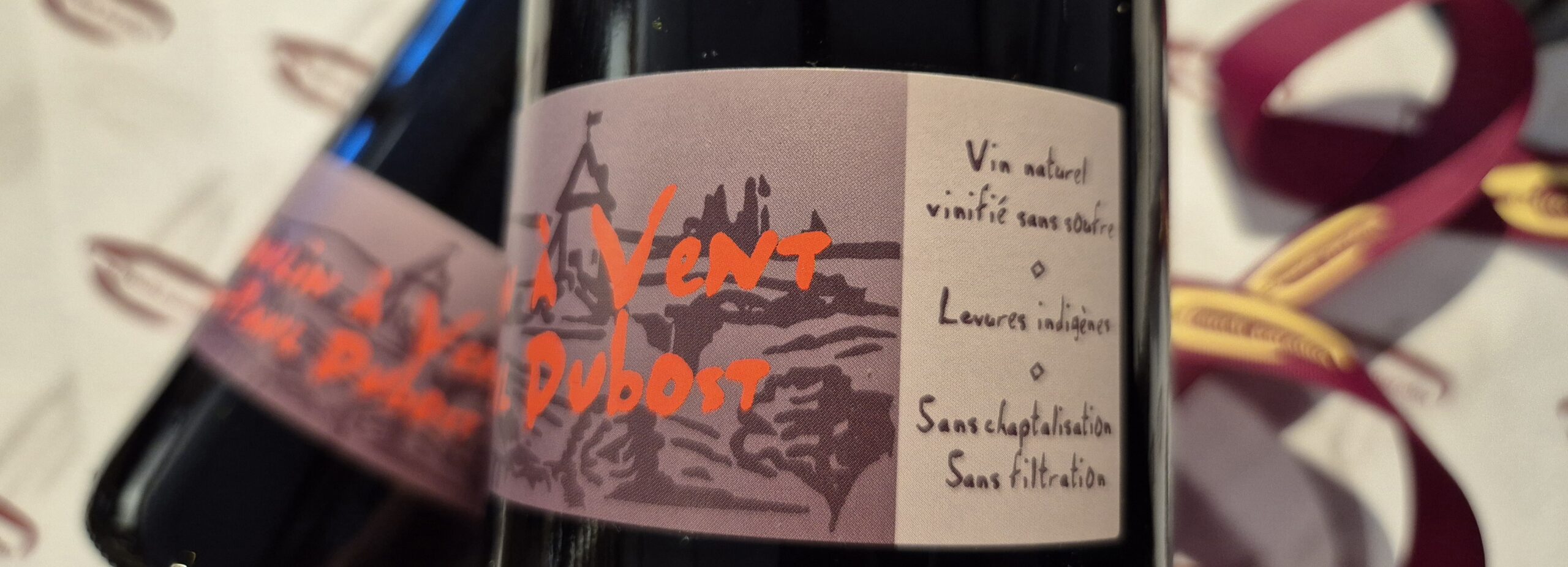
The Moulin-à-Vent 2020 by Jean-Paul Dubost is a perfect example. Crafted from organically farmed vines and made with minimal intervention, it offers a pure and honest expression of both the Gamay grape and one of Beaujolais’ most celebrated terroirs.
Moulin-à-Vent – the king of Beaujolais
Named after the historic windmill that overlooks the vineyards, Moulin-à-Vent has long enjoyed a special reputation among the crus of Beaujolais.
Its soils, rich in granite and manganese, produce wines that are often more concentrated and structured than those found elsewhere in the region. While many Beaujolais wines are known for their immediate charm, Moulin-à-Vent has the ability to age gracefully, developing complexity over many years.
This is one of the reasons it is sometimes referred to as the “Lord of Beaujolais.”
The wines retain the bright fruit and freshness that make Gamay so appealing, but gain additional depth, texture, and longevity.
Three generations of the Dubost family
The story of Domaine Jean-Paul Dubost is first and foremost a family story.
For more than eighty years and across three generations, the family has cultivated vineyards in Beaujolais with the same philosophy: respect for the land, careful farming, and wines that reflect their origin rather than winemaking techniques.
Today, Jean-Paul Dubost continues this tradition while embracing organic viticulture and a more natural approach in the cellar. The objective is simple: allow the grapes and the terroir to speak for themselves.
It is an approach that demands attention and patience, but one that often produces wines with remarkable personality.
What does “no added sulphites” mean?
One of the defining features of this Moulin-à-Vent is the absence of added sulphites.
Sulphur dioxide has traditionally been used in winemaking as a preservative and antioxidant. While it remains an important tool for many producers, some winemakers choose to reduce or eliminate its use entirely in order to preserve the wine’s most natural expression.
Producing a wine without added sulphites requires impeccable fruit quality, careful hygiene, and constant attention throughout the winemaking process.
The goal is not to make a statement, but to allow the fruit to express itself with maximum purity.
Indigenous yeasts and minimal intervention
The natural philosophy continues throughout the vinification.
Rather than adding selected commercial yeasts, fermentation begins with the indigenous yeasts naturally present on the grape skins and in the cellar environment. These native yeasts contribute to the unique identity of the wine and reinforce its connection to its place of origin.
The wine is also produced without chaptalisation — the practice of adding sugar to increase alcohol levels — and without filtration before bottling.
Every decision is guided by a desire to intervene as little as possible and preserve the integrity of the harvest.
Moulin-à-Vent 2020 – purity, energy and depth
The 2020 vintage showcases the strengths of both the appellation and the estate.
The nose reveals aromas of black cherry, raspberry, violet, peony, and subtle spice. With time in the glass, deeper notes emerge, reminding us that Moulin-à-Vent often offers more complexity than people expect from Gamay.
On the palate, the wine combines freshness with structure. The fruit remains vibrant, while fine tannins provide shape and length. There is a sense of energy throughout, balanced by a depth that makes the wine particularly satisfying at the table.
It is expressive without being excessive, and serious without losing its charm.
A different side of Beaujolais
For those who only know Beaujolais through Beaujolais Nouveau, wines like this can be a revelation.
Moulin-à-Vent demonstrates that Gamay is capable of producing wines with remarkable complexity and ageing potential. In the hands of a thoughtful producer like Jean-Paul Dubost, it becomes a wine of place, character, and authenticity.
A wine that trusts its terroir
The philosophy behind this Moulin-à-Vent 2020 is ultimately one of confidence.
Confidence in the vineyard. Confidence in the fruit. Confidence in the natural process of fermentation and ageing.
By choosing organic farming, indigenous yeasts, no chaptalisation, no filtration, and no added sulphites, Jean-Paul Dubost allows the wine to remain remarkably close to its origins.
The result is not simply a bottle of Beaujolais. It is a wine that tells the story of a family, a vineyard, and a region that continues to surprise those willing to look beyond the clichés.


Recent Comments