 Skip to main content
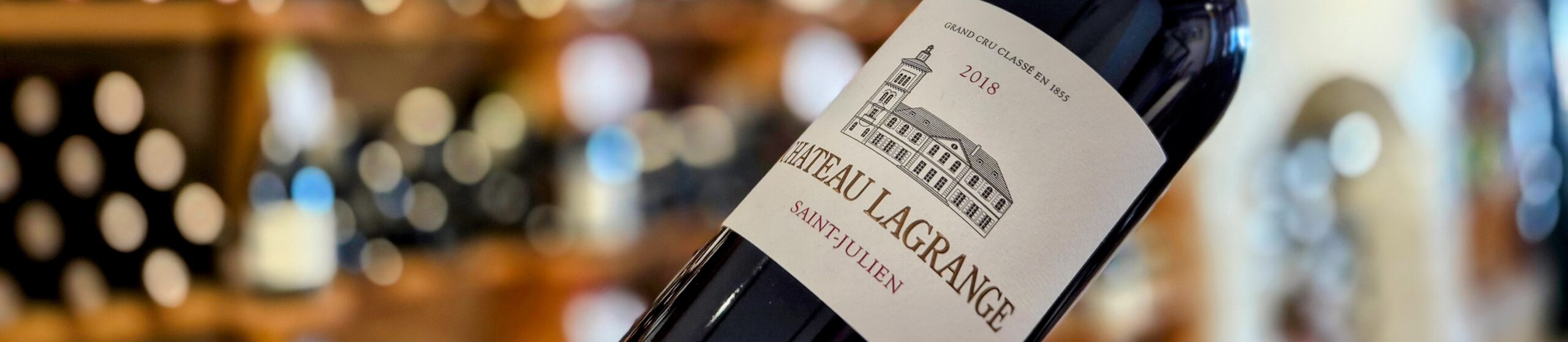
A Left Bank classic shaped by gravel, Cabernet and the Atlantic climate
There are certain Bordeaux names that immediately evoke the Left Bank.
Saint-Julien is one of them.
Nestled between Margaux and Pauillac, this Médoc appellation is famous for producing wines that combine the power of Cabernet Sauvignon with remarkable elegance and freshness.
At the heart of the appellation stands Château Lagrange, a Second Growth of the 1855 classification and one of the great estates of Saint-Julien.
Its 2018 vintage is a particularly expressive example of what this terroir can achieve.
118 hectares, one remarkable terroir
The Château Lagrange vineyard is entirely situated within the village of Saint-Julien.
Its 118 hectares of red vines form one large block, spread across two hills whose slopes face both north and south.
Underneath the vines lies a combination of clay and limestone, while the surface is covered with the gravel and pebbles so characteristic of the Médoc.
These gravelly soils are particularly important for Cabernet Sauvignon.
They drain naturally, retain heat and encourage the vines to develop deep roots, helping to produce grapes with concentration while preserving freshness.
Add the temperate, oceanic climate of Bordeaux, and you have the foundations for a classic Saint-Julien.
Cabernet Sauvignon takes the lead
The 2018 Château Lagrange is built around a traditional Left Bank blend:
67% Cabernet Sauvignon, 28% Merlot and 5% Petit Verdot.
Cabernet Sauvignon provides the backbone, structure and freshness.
Merlot brings roundness and generosity.
Petit Verdot contributes colour, spice and an extra layer of complexity.
The average age of the vines is around 37 years, with planting densities reaching up to 10,000 vines per hectare.
It is a blend designed for both character and longevity.
A vintage of extremes
2018 was an intriguing year in Bordeaux.
The first half of the growing season was exceptionally wet, with rainfall well above the average of the previous two decades.
Then everything changed.
Summer became hot and dry, with some of the driest conditions recorded at Lagrange since 1996. The heat continued through September and October, creating excellent conditions for the final stages of ripening and harvest.
At Lagrange, harvesting took place between 20 September and 13 October 2018.
The grapes were hand-picked into individual crates, followed by two stages of selection: first by hand on whole bunches, then grape by grape using an optical sorting camera.
Precision in the cellar
Château Lagrange takes precision seriously.
The estate has 102 temperature-controlled stainless-steel vats, allowing the team to vinify individual plots separately.
Each batch can therefore be selected according to grape variety, vine age, terroir and maturity.
Traditional fermentation takes place at 26–28°C, with gentle extraction through pumping-over, pigeage or délestage depending on the lot.
After blending in January, the wine spends 21 months ageing in oak barrels, 50% of which are new oak.
The result is then carefully refined before bottling.
Generous, powerful and surprisingly fresh
The 2018 vintage has a deep, dark colour with purple reflections.
The nose is immediately expressive, revealing black cherry, blackcurrant and ripe prune.
On the palate, there is generosity and richness, but also an important freshness that keeps the wine balanced.
The tannins are dense yet remarkably silky, giving the wine both structure and a smooth, almost velvety texture.
It is a powerful Saint-Julien, but not a heavy one.
That freshness is what makes the wine particularly compelling.
A Saint-Julien for the long haul
The estate gives the 2018 a drinking window extending from 2022 to 2050.
That tells you something about the structure of the wine.
It is already approachable, but there is plenty of material for further evolution in bottle. Over time, the dark fruit should gradually give way to the more complex aromas that make mature Bordeaux so fascinating.
For those who prefer their Bordeaux with a little bottle age, 2018 is already entering a very attractive phase.
Why we love Château Lagrange 2018
There is something wonderfully classic about this bottle.
The gravel of Saint-Julien, the dominance of Cabernet Sauvignon, the long élevage in oak and the patience required to let the wine develop all come together.
But the 2018 vintage also brings something extra: generosity.
It is rich without losing freshness, powerful without becoming aggressive, and structured without sacrificing elegance.
A great Saint-Julien doesn’t need to shout.
It simply needs time, a good glass and a little patience.


Recent Comments