 Skip to main content
A limestone landscape, a historic village, and a wine that defines freshness
Some appellations become reference points. Others become symbols. Sancerre is both.
Perched above the Loire Valley, Sancerre is one of France’s most recognisable white wine regions — a place where a single grape variety has become inseparable from its identity. Yet behind the clarity of its wines lies a long history, a complex geology, and a deep culture of parcel-by-parcel expression.
At its heart, Sancerre is about precision: limestone, flint, clay, and a grape that translates all of it with remarkable transparency.
A terroir shaped by three soils
Sancerre is often described through its soils, because they are essential to its identity. Three main types define the appellation:
- Les terres blanches (clay-limestone), bringing structure and depth
- Les caillottes (limestone pebbles), offering finesse and fruit
- Le silex (flint), giving tension and a distinctive smoky, mineral edge
Together, they create a mosaic where Sauvignon Blanc does not have a single expression, but many variations depending on the vineyard.
This is one of the reasons Sancerre has become so important: it shows that even within a small area, terroir can be heard clearly.
Sauvignon Blanc – a grape of clarity and tension
The identity of Sancerre is built on Sauvignon Blanc.
Here, the grape is rarely about exuberance. Instead, it expresses itself through precision: citrus, green fruit, floral notes, and a characteristic mineral backbone. In the best examples, it is not just aromatic, but structured — driven by acidity and shaped by soil.
Sancerre helped establish Sauvignon Blanc globally, influencing styles in New Zealand, South Africa, and beyond. Yet the original expression remains distinct: less tropical, more restrained, and more about texture and tension than pure aromatic intensity.
A village and a history of precision
The village of Sancerre sits on a hill overlooking the Loire. Wine has been produced here for centuries, but its modern identity really took shape in the 20th century, when Sauvignon Blanc became the dominant grape and quality-focused viticulture spread across the appellation.
Today, Sancerre is made up of many small, family-run estates, where vineyard work is often parcel-driven. This shift has allowed winemakers to highlight the differences between individual lieux-dits, giving more depth and complexity to the region’s identity.
It is no longer just “Sancerre” as a single style, but a collection of terroirs expressed through a shared grape.
Domaine Fouassier – one of Sancerre’s historic voices
Among the families deeply rooted in the region, Domaine Fouassier holds a particularly important place.
The estate has been in the Fouassier family for over ten generations, and today it is run with a clear focus on organic and biodynamic viticulture. Their philosophy is simple but demanding: to express each parcel as honestly as possible, with minimal intervention in the cellar and a strong respect for the vineyard.
They were also among the early pioneers of bottling single vineyard expressions in Sancerre, helping to shape the modern understanding of terroir within the appellation.
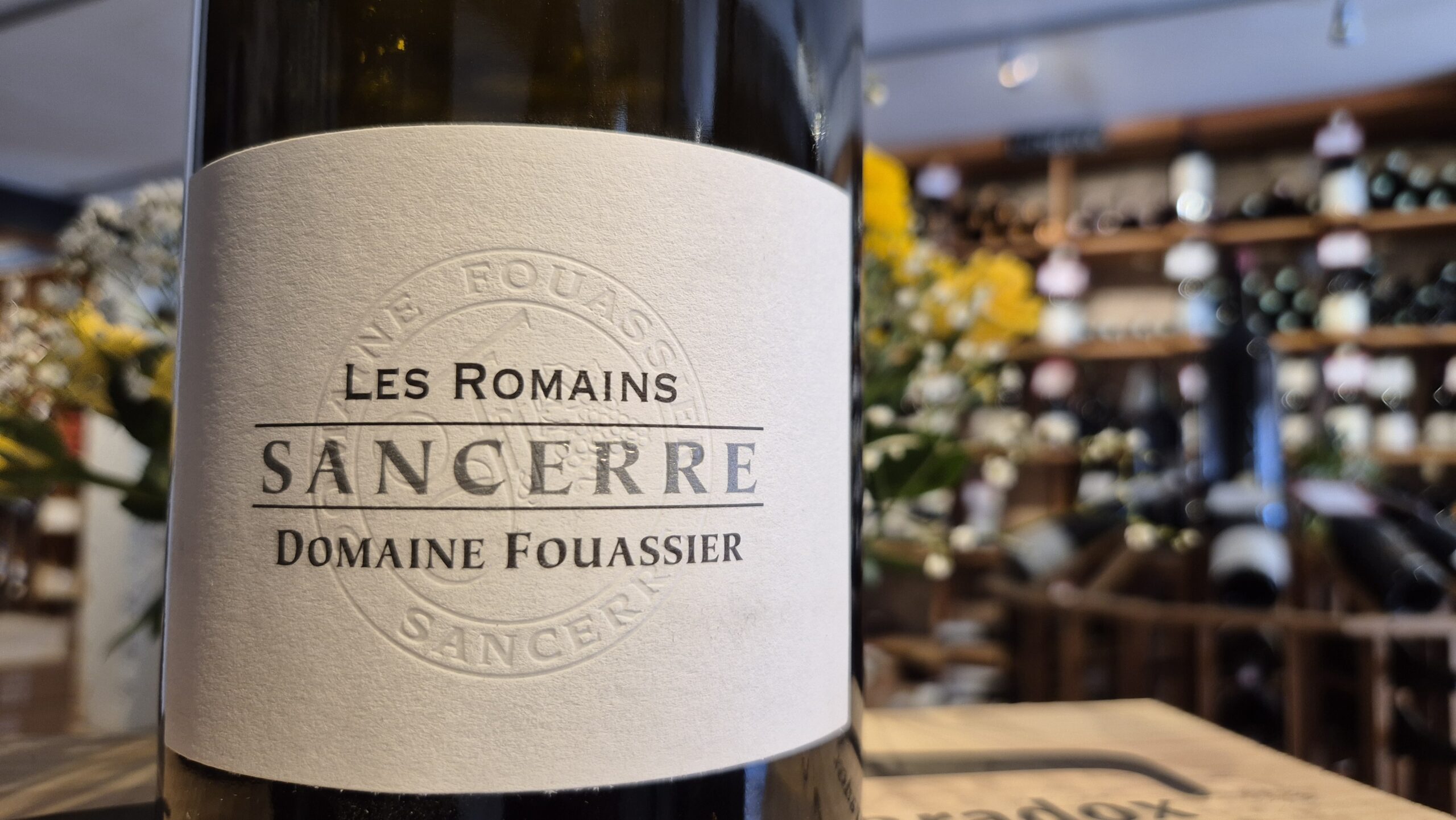
Magnum of Les Romains 2022 – a single vineyard expression
Among their most expressive cuvées, Les Romains 2022 stands out as a precise interpretation of a specific site.
Sourced from a walled vineyard on limestone-clay soils with flint influence, it reflects the idea of a “clos” — a defined, enclosed parcel with its own identity.
In the glass, the wine shows a refined balance between ripeness and tension. Aromas of ripe pear, citrus zest, white flowers, and wet stone open gradually, while the palate combines volume with a firm mineral backbone. The texture is smooth yet structured, carried by a fine acidity that gives length and energy.
There is generosity here, but also control — a wine that feels complete rather than demonstrative.
A modern expression of Sancerre
Clos Paradis is also representative of where Sancerre stands today. The region is no longer defined only by freshness and immediacy, but increasingly by depth, ageing potential, and a clearer articulation of terroir.
Producers like Domaine Fouassier have played a key role in this evolution, showing that Sauvignon Blanc can be both expressive and serious when treated with care.
A landscape in a glass
Sancerre remains one of the clearest examples of what terroir-driven wine can be. It is not about power or opulence, but about precision — the ability of a grape to translate soil, climate, and place into something readable.
With Les Romains 2022, that idea becomes particularly clear. It is a wine that does not simply represent Sancerre — it helps explain it.
In the end, Sancerre is not just a style of wine. It is a landscape, captured in glass.


Recent Comments